Optimization On this page Loss Loss is a measure of difference between predicted output
Unreduced loss:
Reduced loss: $\mathcal{L}(\mathbf{y},\mathbf{\hat{y}})=\begin{cases}
\text{sum}(\mathcal{L})=\sum_{i=1}^{m}l_i\\
\text{mean}(\mathcal{L})=\frac{1}{m}\sum_{i=1}^{m}l_i
\end{cases}$ (can impose sample weights as well) Regression# L1 (Absolute Error)# Pros:
Cons:
Non-differentiable Less related to the underlying assumption of Gaussian distribution on the errors (for most problems) L2 (Squared Error)# $$
\mathcal{l}_i=(y_i-\hat{y}_i)^2
$$
Pros:
Penalize large errors more heavily Differentiable Closely related to the underlying assumption of Gaussian distribution on the errors (for most problems) Cons:
Huber# $$
l_i(\delta)=\begin{cases}
\frac{1}{2}(y_i-\hat{y_i})^2 & \text{if }|y_i-\hat{y_i}|\leq\delta\\
\delta|y_i-\hat{y_i}|-\frac{1}{2}\delta^2 & \text{if }|y_i-\hat{y_i}|>\delta
\end{cases}
$$
Pros:
A mixture of L1 and L2 losses Cons:
Less used than either L1 or L2 Classification# 0-1 (Heaviside)# $$
l_i=\begin{cases}
0 & \text{if }y_i\hat{y_i}>0\\
1 & \text{if }y_i\hat{y_i}<0
\end{cases}, y_i\in\{-1,1\}
$$
Usage: Naive Bayes
Cons:
Penalize all incorrect predictions equally Non-convex Non-differentiable Hinge# $$
l_i=\max{(0,1-y_i\hat{y}_i)}, y_i\in\{-1,1\}
$$
Usage: SVM
Pros:
Allow misclassification (penalize more heavily for confident incorrect predictions than for uncertain predictions) No penalty on confident correct predictions Convex Cons:
Logistic# $$
l_i=\frac{1}{\log{2}}\log{(1+e^{-y_i\hat{y_i}})}, y_i\in\{-1,1\}
$$
Usage: LogReg
Pros:
Cons:
Penalize confidently correct predictions Penalize confidently incorrect predictions less compared to other losses Exponential# $$
l_i=e^{-y_i\hat{y}_i}, y_i\in\{-1,1\}
$$
Usage: AdaBoost
Pros:
Convex Differentiable Much heavier penalty on much stronger misclassification (effective for weight assignments to examples for AdaBoost) Cons:
Penalize confidently correct predictions Squared# $$
l_i=(1-y_i\hat{y}_i)^2, y_i\in\{-1,1\}
$$
Usage: rare
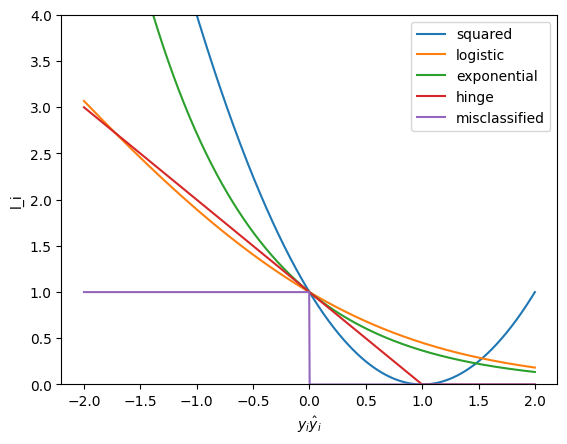
Visualization of all the above losses:
Cross Entropy# Usage: most (= Log loss for binary, with a much more prevalent label definition)
Pros:
Extremely easy to compute (all terms become 0 except one) Cons:
Sensitive to imbalanced datasets Kullback-Leibler Divergence (Relative Entropy)# $$
l_i=y_i\log\frac{y_i}{\hat{y}_i}
$$
Usage: anywhere necessary to calculate difference between true and predicted probability distributions (i.e., information loss)
Regularization Regularization reduces overfitting by adding our prior belief onto loss minimization (i.e., MAP estimate). Such prior belief is associated with our expectation of test error. Regularization makes a model inconsistent, biased, and scale variant. Regularization requires extra hyperparameter tuning. Regularization has a weaker effect on the model (params) as the sample size increases, because more info become available from the data. Explicit (Penalty)# Pros:
Sparse
Robust to outliers Equal weight shrinkage (
Effective with multicollinearity Able to handle
Cons:
No closed-form solution (high computational cost with LinReg) Need to select perfect
Pros:
More/Less shrinkage on larger/smaller weights (
Effective with multicollinearity Closed-form solution. Low computational cost with LinReg Cons:
No sparsity
Not robust to outliers Not able to handle
Need to select perfect
Elastic Net# $$
\lambda(r_{\text{L1}}||\mathbf{w}||_1+(1-r_{\text{L1}})||\mathbf{w}||_2^2)
$$
Pros:
A mixture of L1 and L2 penalties Cons:
Less used than either L1 or L2 Optimization: Search
Common Pros:
Explicit feature selection
Common Cons:
Severe limitations in optimization methods Extreme computational cost Implicit# tbd
Parameter Optimization The word “Learning” in ML is literally just parameter estimation (i.e., objective optimization). Pure statistics.
Gradient Descent# $$
\boldsymbol{\theta}\leftarrow\boldsymbol{\theta}-\eta\nabla\mathcal{L}(\boldsymbol{\theta})
$$
Types:
Stochastic GD: update params for each single sample Mini-Batch GD: update params for each mini-batch of samples Batch GD: update params after observing all samples Pros:
Cons:
Cannot find global minimum ifbad step size: too big then unstable; too small then taking too long non-convex objective: stuck at local minima or saddle point Adagrad# Idea: tune the learning rate so that the model learns slowly from frequent features but pay special attention to rare but informative features.
$$
\eta_{tj}=\frac{\eta}{\sqrt{\sum_{\tau=1}^t(\frac{\partial\mathcal{L}_k}{\partial{\theta_j}})^2}+\epsilon}
$$
Expectation-Maximization# Idea: learn model (do MLE/MAP on params) with latent variables (NOT explicit for GMM).
Method:
Init params
E-step: estimate
Estimate the expected value of the latent variables given the current estimates of the model params and the data. M-step: estimate
Estimate the model params through MLE or MAP on the expected value of the complete data likelihood. Repeat Step 2-3 until convergence. Pros:
Offer estimates for both latent variables and model params Cons:
NOT guaranteed to find optimum
Hyperparameter Tuning tbd
Evaluation In regression, MAE/MSE/RMSE is used for both training and evaluation.
In classification, there are various metrics mostly centered at the idea of confusion matrix .
Confusion Matrix# Confusion Matrix is a
An example of confusion matrix for binary classification:
True P True N Predicted P TP FP Predicted N FN TN
Notations:T&F = whether prediction matches actual P&N = predicted class FP = type 1 error FN = type 2 error Metrics:Error Rate :
Accuracy :
Specificity : TN rate among negative actual values:
1-Specificity (FPR) : FP rate among negative actual values:
Precision : TP rate among positive predicted values:
Recall : TP rate among positive actual values:
F-score : harmonic mean of Precision and Recall:
F1-score :
ROC (Receiver Operating Curve): plot of TPR vs FPRAUC (Area Under Curve): area under ROC curve
Distance & Similarity Norm & Distance# Norm is NOT a distance measure but a size measure. It offers insights for many prevalent distance measures.
Properties:
Types:
Cosine Similarity# tbd
Kernel# Def: measure of similarity between 2 vectors.
Properties:
PSD:
 .
.



 Feature selection (reduce weights of trash features to 0)
 )
) cases
cases

 )
) : L1 ratio
 .
. in range(1,n+1):
 to model.
 :
:


 to model.
 :
: :
:

 .
. :
: to cache.
 Sparsity
 .
. " (MAP).
 matrix which visualizes actual classes against predicted classes.


 is positive semi-definite.
 .
. : non-negative real eigenvalues.
 : real eigenvectors.

 is polynomial func with positive coeffs.

